E-means: 10x faster k-means at equal loss 翻译 背景介绍
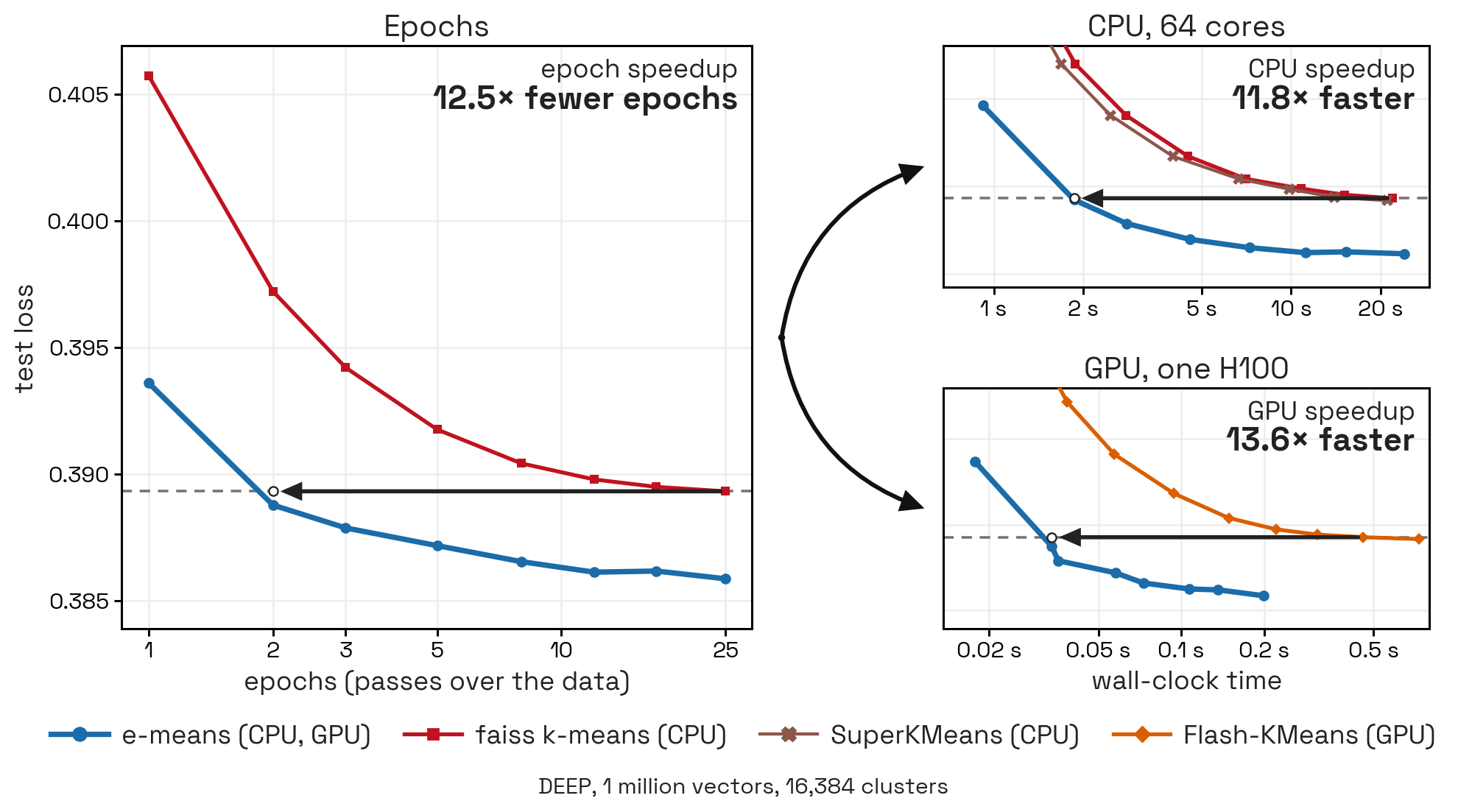
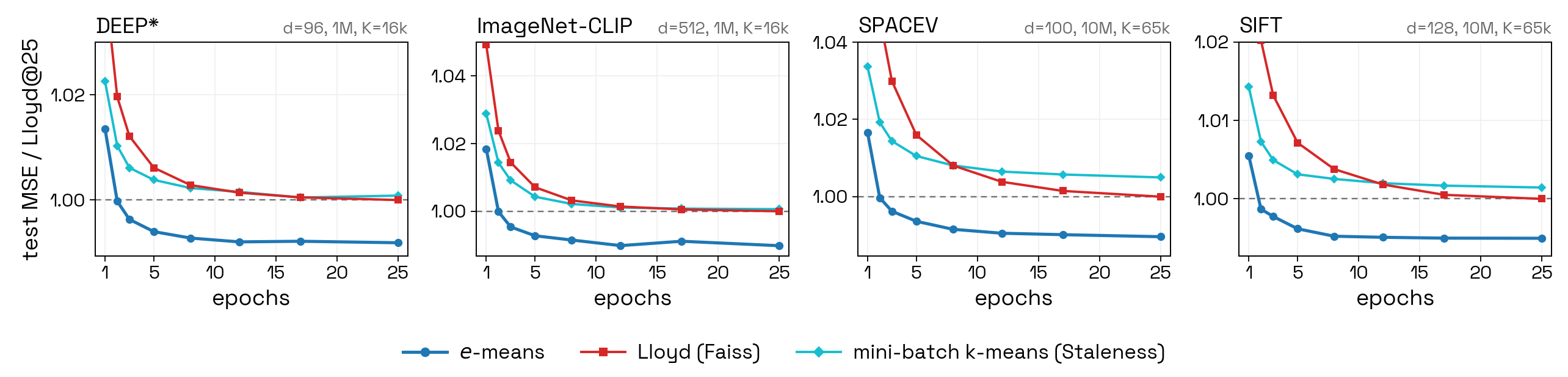
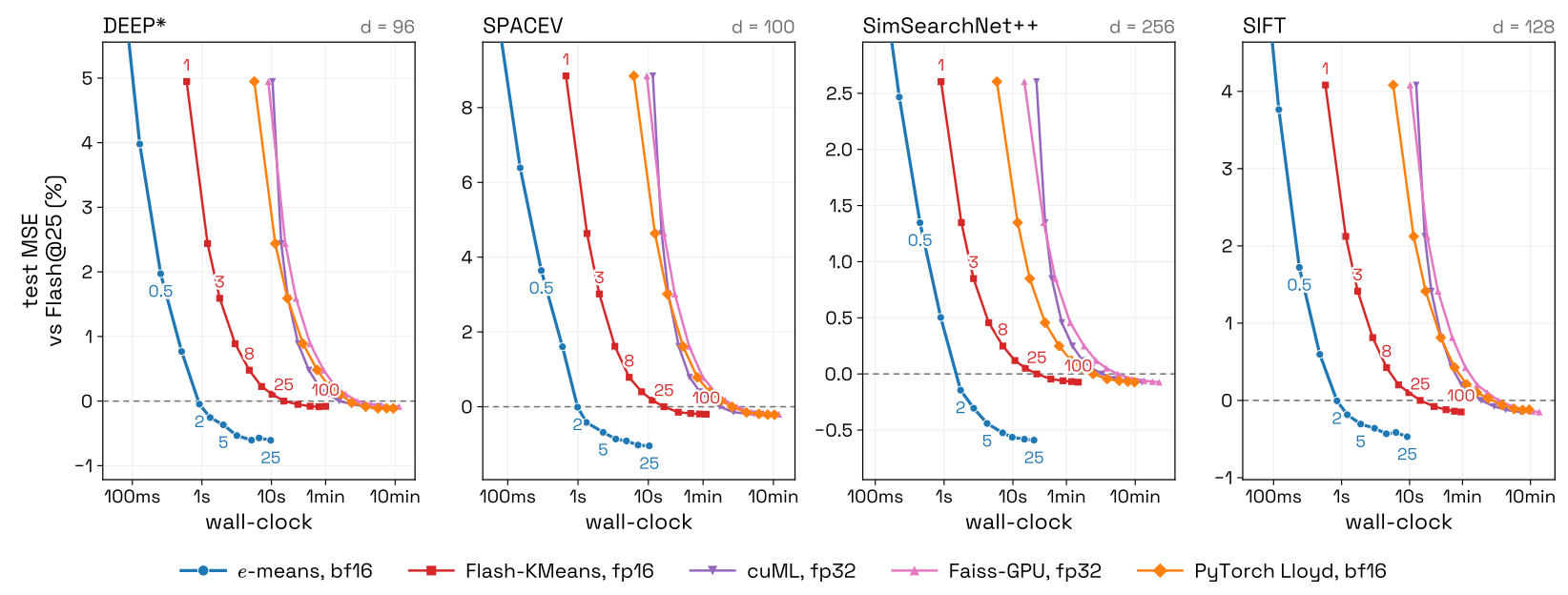
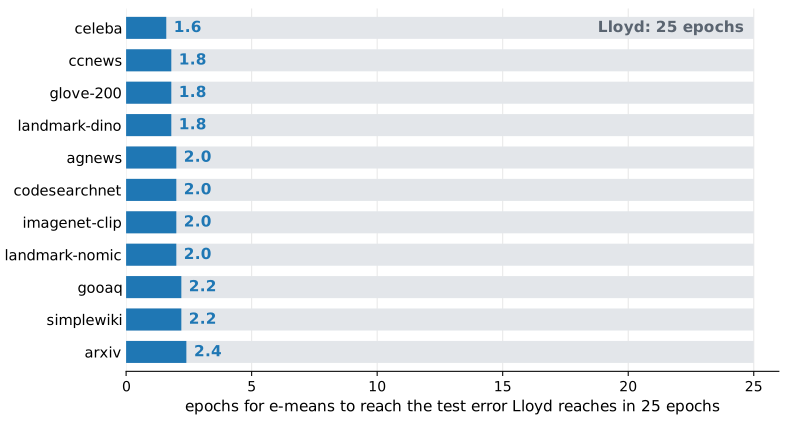
An order of magnitude less epochs Across a large range of scales and datasets , e-means reaches a test loss below Lloyd's at 25 epochs , in 1.2 to 3 epochs . Measured end to end , that is a 10–45× wall-clock reduction on GPU against the state-of-the-art Lloyd implementation (Flash-KMeans [2]), and 8–15× on CPU against Faiss [1]. Speed and quality usually trade against each other in k-means , while e-means achieves both better speed and loss .
The k-means problem Given a fixed dataset of n points X = {x 1, ..., xn } ⊂ Rd and an integer k , the k-means problem is to find k centroids C = (c 1, ..., ck ) minimizing the mean squared distance between each point and its nearest centroid :
\[ \mathrm {MSE }(X , C ) = \frac {1}{n } \sum _{i =1}^{n } \|x _i - c _{a (i )}\|^2, \qquad a (i ) = \arg \min _{j \in \{1,\dots ,k \}} \|x _i - c _j \|^2 \]
\[ \mathrm {MSE }(X , C ) = \frac {1}{n } \sum _{i =1}^{n } \|x _i - c _{a (i )}\|^2 \]
\[ a (i ) = \arg \min _{j \in \{1,\dots ,k \}} \|x _i - c _j \|^2 \]
It's a static dataset , unlike codebook learning inside VQ-VAEs , where the distribution to cluster is constantly moving .
The e-means project The goal of e-means is to provide a modern optimization rule for the k-means problem . We started this project from the following observations :
k-means is one of the rare problems in machine learning where full-batch optimization is still widely used .Mini-batch k-means methods in the literature exist [3],[4],[5], but are mostly based on the MacQueen update rule , released in 1967.Modern deep learning offers optimization tools that can enhance mini-batch methods .For e-means , we chose to do mini-batch updates with exponential moving averages [6], which we found to be most efficient for the k-means problem . Contrary to previous mini-batch approaches , e-means requires no hyperparameter tuning because it automatically sets the batch size and step size with scaling laws (see Automatic hyperparameter tuning with scaling laws ). In addition , e-means improves the initialization and the dead-cluster revival strategy , adds a cosine-scheduled decay rate , and introduces a finalization stage that reduces the training loss for a negligible runtime penalty at the end of training . e-means is highly parallelizable , and comes with specialized kernels that translate its algorithmic advantage into wall-clock speedups .
Each mini-batch updates every cluster's count and sum . The centroid is their ratio .
Everything is derived from scaling laws .
Novel initialization and finalization methods . The run ends on each cluster's exact last-epoch mean .
The step α anneals from α0 to 0.1α0, as a learning rate does .
Clusters with size below a threshold are revived by splitting a large cluster .
GPU kernels fuse the nearest-centroid assignment , turning the epoch savings above into matching wall-clock speedups .
The centroid update rules The centroid update rule is the central component of e-means . This section aims to provide an overview of update rules for k-means clustering . All methods maintain , for each cluster j , a sum Sj and a count Nj of the points assigned to it , and take the centroid as their ratio :
They differ only in how Sj and Nj are updated . Below , sj and nj denote the sum and the count of the points in the current batch that are assigned to cluster j (both zero if none are ).
Lloyd’s algorithm [7] assigns every point to its nearest centroid and recomputes the statistics from scratch , using the full dataset as the batch :
\[ S _j \leftarrow s _j , \qquad \quad N _j \leftarrow n _j \]
so cj is the exact mean of the points currently assigned to it . Each update costs one full pass over the data , and the procedure is repeated a fixed number of times (typically 20 to 50 iterations ).
MacQueen’s update [3] accumulates the statistics without ever discarding them :
\[ S _j \leftarrow S _j + s _j , \qquad \quad N _j \leftarrow N _j + n _j \]
so cj is the uniform mean of every point assigned to cluster j since the start of training , including points assigned under earlier , possibly poor , centroid positions . This was later partially addressed by Staleness-Reduction Mini-Batch K-Means [8], a hybrid method between k-means and MacQueen . They obtained important speedups , but only on very low numbers of clusters .
e-means works on mini-batches and replaces this sum with an exponential moving average :
\[ S _j \leftarrow (1-\alpha )\,S _j + \alpha \, s _j , \qquad \quad N _j \leftarrow (1-\alpha )\,N _j + \alpha \, n _j \]
\[ S _j \leftarrow (1-\alpha )\,S _j + \alpha \, s _j \]
\[ N _j \leftarrow (1-\alpha )\,N _j + \alpha \, n _j \]
so older assignments are forgotten at rate α, and the centroid tracks recent assignments rather than the whole history . This update rule is typically used for moving distributions , hence their adoption for training VQ-VAEs [6]. What we found is that it’s also extremely efficient for static datasets if it’s combined with e-means ’ other components , and hyperparameters are properly tuned .
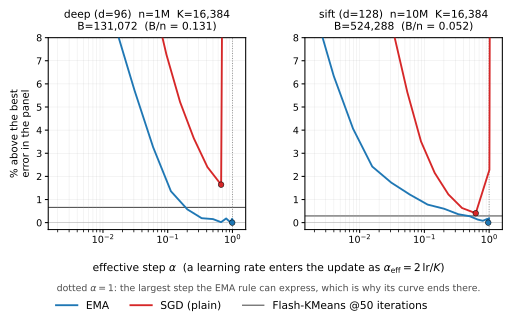
The e-means project started from previous work at Meta FAIR by Hugo Touvron and Herv é J égou , who had found that mini-batch k-means by gradient descent could beat Lloyd’s algorithm . While I could reproduce these results , I found that the performance of gradient-descent based centroid updates is unstable at large learning rates , unlike exponential moving average updates . I suspect that is because EMA updates guarantee that the centroid is always in the convex hull of points assigned to it , while gradient descent updates may overshoot past that hull .
Test error against the effective step a centroid takes, at a large batch, for exponential-moving-average updates (EMA) and plain gradient descent (SGD), each at every step setting tried. DEEP, 1 million vectors, and SIFT, 10 million vectors, 16,384 clusters, 5 epochs, median over 3 seeds. The vertical axis is percent above the best test error in the panel. At its best setting, gradient descent ends 1.6% (DEEP) and 0.4% (SIFT) above the moving average. In order to achieve the lowest loss at a fixed number of epochs , we chose exponential moving average updates , hence the name e-means for our method .
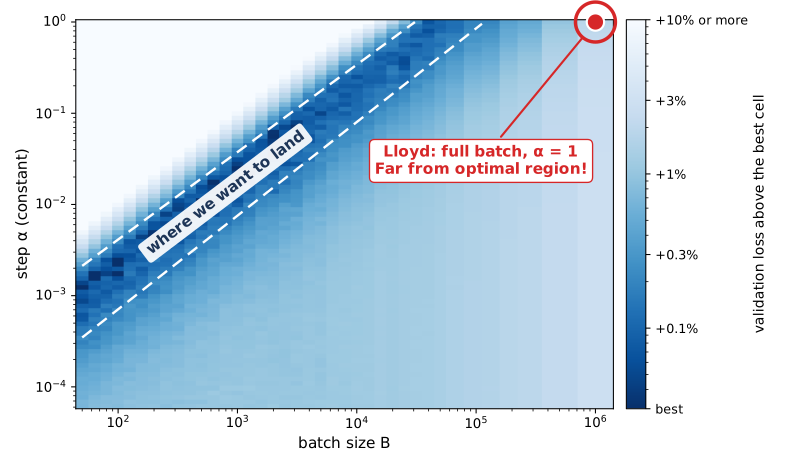
If you set the batch to the full dataset , B = n , and α = 1, then Nj and Sj become exactly the count and sum of the whole cluster , so one e-means iteration becomes exactly one Lloyd iteration . Lloyd is an extreme case of e-means without cosine scheduling on the learning rate . However , our hyperparameter search found that this extreme setting is highly suboptimal , which explains why e-means largely outperforms Lloyd . Below , the loss is measured for every batch size B and step α: Lloyd lands in a corner , well outside the region where the loss is lowest .
B α n 6 k α This hyperparameter study motivated us to derive scaling laws that automatically pick the optimal batch size B and step size α.
e-means better escapes local minima To better understand why e-means reaches better losses than Lloyd at convergence , we plotted a few trainings on toy datasets to evaluate their ability to escape local minima . Repeating trainings over 200 seeds , we found that e-means is much less likely to fall in pathological configurations compared to Lloyd .
Our explanation for that is that mini-batches provide more noisy updates that are more likely to explore the optimization landscape and escape local minima . Lloyd , with its always decreasing loss , is more likely to exploit found local minima and never escape them .
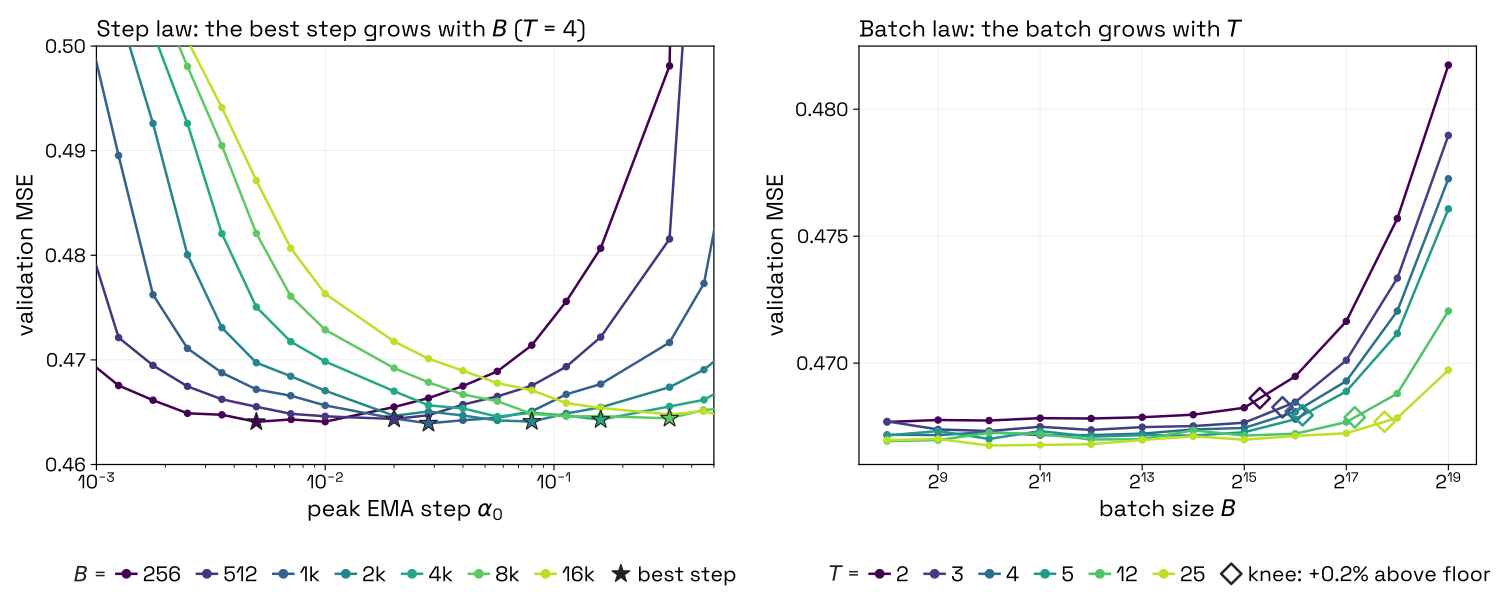
Automatic hyperparameter tuning with scaling laws An essential property of e-means is that practitioners don't need to set any additional hyperparameter compared to Lloyd's algorithm . We fitted two scaling laws to set the batch size B and step size α0 from any problem's characteristics (n , k , T ), and found them to exhibit strong generalization on unseen datasets and problem scales .
\[ B = c _B \, k ^{b _k } \, n ^{b _n } \, T ^{b _T } \]
\[ \alpha _0 = \min \!\Big (c _\alpha \, k ^{a _k } \, B ^{a _B } \, n ^{a _n } \, T ^{a _T },\; 1\Big ) \]
Regret = (MSE with the law − best MSE over the grid ) / best MSE , median over configurations . Held-out datasets : SIFT , SPACEV , and the VIBE [9] datasets arXiv and AG-News . Held-out size : one value of n left out of the fit and predicted .
We propose two equations to choose the batch , the default law and the quality law . The “quality law ” trades off throughput for better clustering quality against the “default ” law . Below we plot the training data for our scaling laws : validation MSE against step size α0 (left ) and batch size B (right ).
The importance of dead-cluster revival Toy example showing the importance of dead-cluster revival .
The main issue with mini-batch k-means is that it is prone to “dead ” clusters , centroids that end up with zero assigned points during optimization . This reduces the effective size of the codebook , which is especially problematic for the large codebooks increasingly used today .
A common mitigation is to reinitialize clusters that fall below a certain size threshold , as done in EnCodec [10], where dead centroids are simply replaced by random samples drawn from the incoming batch . While this helps , it does not fully resolve the issue . Instead of sampling arbitrary points from the batch , we revive dead clusters by splitting large , existing ones : we sample an active cluster with probability proportional to its size and split it into two . We found this approach , adapted from Faiss k-means , to be significantly more effective at eliminating dead clusters and preserving codebook capacity .
1 million vectors , k = 16,384, 5 epochs , mean over 5 seeds ; only the revival policy varies . A cluster counts as dead when fewer than ten vectors are assigned to it at the end , a thousandth of an average cluster . Imbalance : how uneven the cluster sizes are (1 = all equal ). From the paper’s revival ablation table .
Extensive experimental validation We validated e-means on 24 different embedding and synthetic datasets and configurations (see paper ). For the video we ran 234 configurations of e-means against k-means (16 datasets , 100k to 100M points ): explore every curve in the results map .
Test MSE, divided by Lloyd’s after 25 epochs. Initialized from random vectors. [2] d k
Library and code from faiss .contrib .e _means import Emeans # NumpyEmeans for NumPy em = Emeans (d , k , nepochs =T ) # T epochs (5 by default ) centroids , labels = em .train (x ) # x : a PyTorch tensor (n , d ) # labels : each vector's cluster in the last epoch
Repo : faiss /contrib /e _means .
Citing this work If you use e-means , please cite the paper (arXiv :2611.09501):
@misc {bessa 2026emeansoutperformingkmeansin , title ={e-means : outperforming k-means (in one-tenth the epochs )}, author ={Swann Bessa and Pierre-Emmanuel Mazar é and Gergely Szilvasy and Hugo Touvron and David Picard and Matthijs Douze and Herv é J égou }, year ={2026}, eprint ={2611.09501}, archivePrefix ={arXiv }, primaryClass ={cs .LG }, url ={https ://arxiv .org /abs /2611.09501}, }
References M . Douze , A . Guzhva , C . Deng , J . Johnson , G . Szilvasy , P .-E . Mazar é, M . Lomeli , L . Hosseini , H . J égou . "The Faiss library ." arXiv :2401.08281, 2024. ↑S . Yang , H . Xi , Y . Zhao , M . Li , X . Fan , J . Zhang , H . Cai , Y . Lin , X . Li , K . Keutzer , S . Han , C . Xu , I . Stoica . "Flash-KMeans : Fast and Memory-Efficient Exact K-Means ." arXiv :2603.09229, 2026. ↑J . MacQueen . "Some Methods for Classification and Analysis of Multivariate Observations ." Proceedings of the Fifth Berkeley Symposium on Mathematical Statistics and Probability , 1:281–297, 1967. ↑D . Sculley . "Web-Scale K-Means Clustering ." WWW , 2010. ↑J . Newling , F . Fleuret . "Nested Mini-Batch K-Means ." NeurIPS , 2016. ↑A . van den Oord , O . Vinyals , K . Kavukcuoglu . "Neural Discrete Representation Learning ." NeurIPS , 2017. ↑S . Lloyd . "Least squares quantization in PCM ." IEEE Transactions on Information Theory , 28(2):129–137, 1982 (circulated as a Bell Labs technical note since 1957). ↑X . Zhu , J . Sun , Z . He , J . Jiang , Z . Wang . "Staleness-Reduction Mini-Batch K-Means ." IEEE Transactions on Neural Networks and Learning Systems , 35(10):14424–14436, 2024. ↑E . J ääsaari , V . Hyv önen , M . Ceccarello , T . Roos , M . Aum üller . "VIBE : Vector Index Benchmark for Embeddings ." arXiv :2505.17810, 2025. ↑A . D éfossez , J . Copet , G . Synnaeve , Y . Adi . "High Fidelity Neural Audio Compression ." Transactions on Machine Learning Research , 2023. arXiv :2210.13438. ↑